
The New HPE Curriculum: What does it mean for PE in Years 1-8?
Date: 5 Oct 2026
The release of the refreshed Health and Physical Education (HPE) curriculum marks an important point for teachers. Working alongside primary and intermediate kaiako as they make sense of the changes, our first impression is that this is a much-improved document from the draft. It provides greater clarity about what learners are expected to know and practise, while giving teachers room to use the contexts, activities and approaches that make sense for their learners.
One of the most important shifts is the move towards more explicit knowledge and practices. Rather than leaving teachers to interpret broad curriculum ideas, the curriculum sets out organised learning across Phases 1–4. For PE, this gives us a clearer opportunity to think about progression: what do we want ākonga to know, understand and be able to do as they move through the years?
A clearer structure, with the same shared purpose
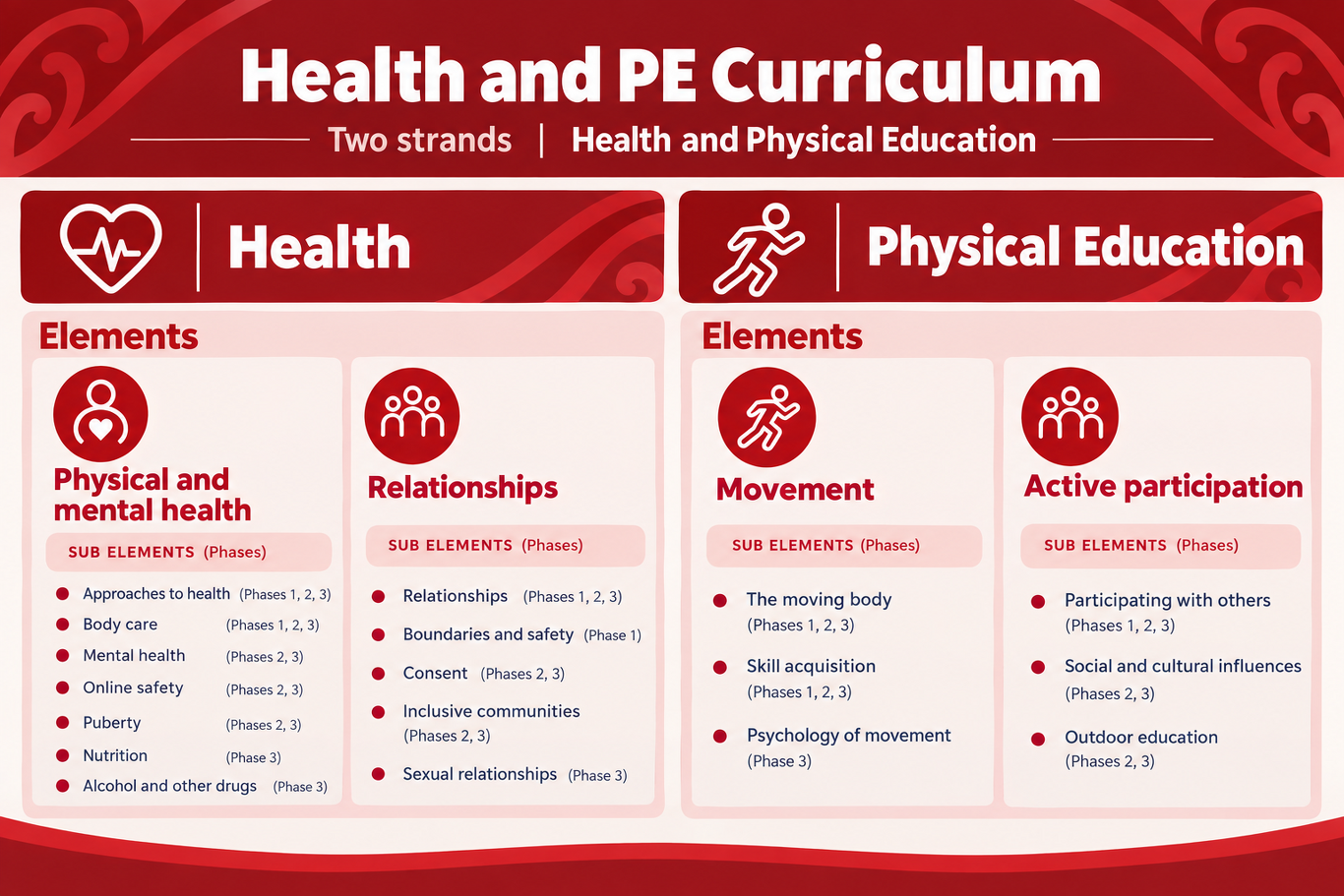
Health and Physical Education are now presented as stand-alone strands. This does not mean they need to be taught separately. There are still many opportunities for knowledge from Health and PE to connect. This is an important distinction. Separation in the structure does not require separation in our teaching.
The whakataukī remains - He oranga ngākau, he pikinga waiora – a positive feeling in your heart will raise your sense of self-worth. Wellbeing continues to sit at the heart of the learning area.
This provides a useful reminder that although the curriculum is now more explicit about knowledge and practices, the purpose of HPE remains broader than learning about isolated skills or facts. Our role is to create learning that supports the wellbeing of ākonga and helps them make sense of themselves, and others to make informed decisions, understand perspectives and participate in healthy active lives.
Some good news:
Hauora has returned from the draft and is explicitly located within Health knowledge.
Outdoor education has returned from the draft and is explicitly located in the Physical Education knowledge
Knowledge and Practices – teaching requirements
This is the minimum expectation of what students should access through curriculum.
It’s not all new! The curriculum provides explicit knowledge and practices across Phases 1–4, creating a more visible progression of learning. For many teachers, there will be a reassuring amount that looks familiar. The change is not necessarily that we have suddenly been asked to teach completely different things; it is that the curriculum now makes the learning more explicit.
Knowledge and practice alignment – the knowledge practices relate but are not an exact match. Multiple knowledge statements may connect to a practice, and at times knowledge statements might have no direct practice. Their relationship is not fixed. Sometimes the knowledge will lead and the practice will consolidate; in other times the practice will lead to explicit links to the knowledge.
Knowledge and practice alignment – the knowledge practices relate but are not an exact match. Multiple knowledge statements may connect to a practice, and at times knowledge statements might have no direct practice. Their relationship is not fixed. Sometimes the knowledge will lead and the practice will consolidate; in other times the practice will lead to explicit links to the knowledge.
What is new for PE?
Participation suggestions
Each phase includes suggestions of games and activities that may be considered as learning experiences. These are not compulsory contexts. Instead, they provide ideas about what the learning could look like and help demonstrate how experiences might become more complex across the phases. This is an important distinction: the curriculum identifies the learning; teachers select and shape the context.
Movement knowledge
The Movement element contains much of the new learning for PE, especially in the lower phases. It makes explicit knowledge and practices about how and what happens when we move, and how movement skills are developed. This gives us a stronger basis for teaching beyond simply providing opportunities to practise a skill. It asks us to consider what learners understand about movement and how that understanding develops through experience.
Water safety
Aquatics is now framed as water safety, with required learning in Phase 1, across Years 1–3, and Phase 2, across Years 4–6. This makes the expectation clearer and places the emphasis on the knowledge and practices learners need to participate safely around water.
Multi-level learning
For teachers working across multiple year levels, the curriculum introduces an important planning consideration. Teachers are expected to provide access to all the knowledge and practices across one year for the year group being taught. Where a teacher is responsible for multiple year levels, all of the relevant knowledge and practices need to be available across the span of those years. For example, if you are teaching Years 1–3, you would work across the three years to ensure the full range is addressed; you would not be expected to teach every statement from Years 1-3 in a single year.
What has gone?
Some familiar curriculum language has changed.
- The key competencies have been replaced by capabilities: communication, collaboration, self-management, problem solving and creativity.
- The underlying concepts are no longer presented as individual concepts; instead, they have informed the knowledge within the curriculum.
- The key areas of learning are also no longer a separate organising feature, with these ideas now considered through the knowledge and practices identified.
A curriculum without prescribed contexts
One of the most important messages for PE teachers is that there continues to be no contexts within our curriculum. Athletics, games, gymnastics, swimming, dance, or any other context can be valuable when it is used purposefully to develop the intended learning.
Balance
Alongside this is the understanding that no one piece of knowledge or practice is more important than another simply because it sits within a familiar or popular context. Year by year our students are required to have access to the full breadth of knowledge and practices as outline in the curriculum.
Where to from here?
There is no need to rush to rewrite everything. With Years 1–8 implementation not compulsory until 2029, there is valuable time to become familiar with the curriculum and consider what it means for your current practice. PENZ’s advice is to take it slowly and use the next couple of years to build understanding rather than creating a completely new programme overnight.
A useful place to start is simply to interact with the content. Read through the knowledge and practices for your year or phase. Put them alongside your current plans and trace what you are already teaching. You may find that much of your existing practice is already there. Then begin to identify the places where progression, explicit teaching or depth of learning might need to be more focused.
This is an opportunity to look critically at our current programmes. Rather than asking, “What activity are we teaching this term?”, we can start with, “What do our learners need to know and practice?” From there, we can select or reshape contexts that bring that learning to life. This is a shift from context driving the learning to learning driving the context.
2029 is not the year we need to have perfect programmes in place. As teachers’ learning and development continue to evolve, so too will our teaching and learning programmes. Rather, 2029 is the year that teaching and learning in HPE is mandated to begin. We also have the freedom to start exploring, trialing and experimenting with the new curriculum well before 2029.
The refreshed curriculum gives us a clearer map, but it does not prescribe the journey. Our challenge as PE teachers is to use that map thoughtfully: to provide access to the full breadth of learning, choose contexts that work for our learners, and make the learning, rather than the activity, the purpose of Physical Education.
Back...